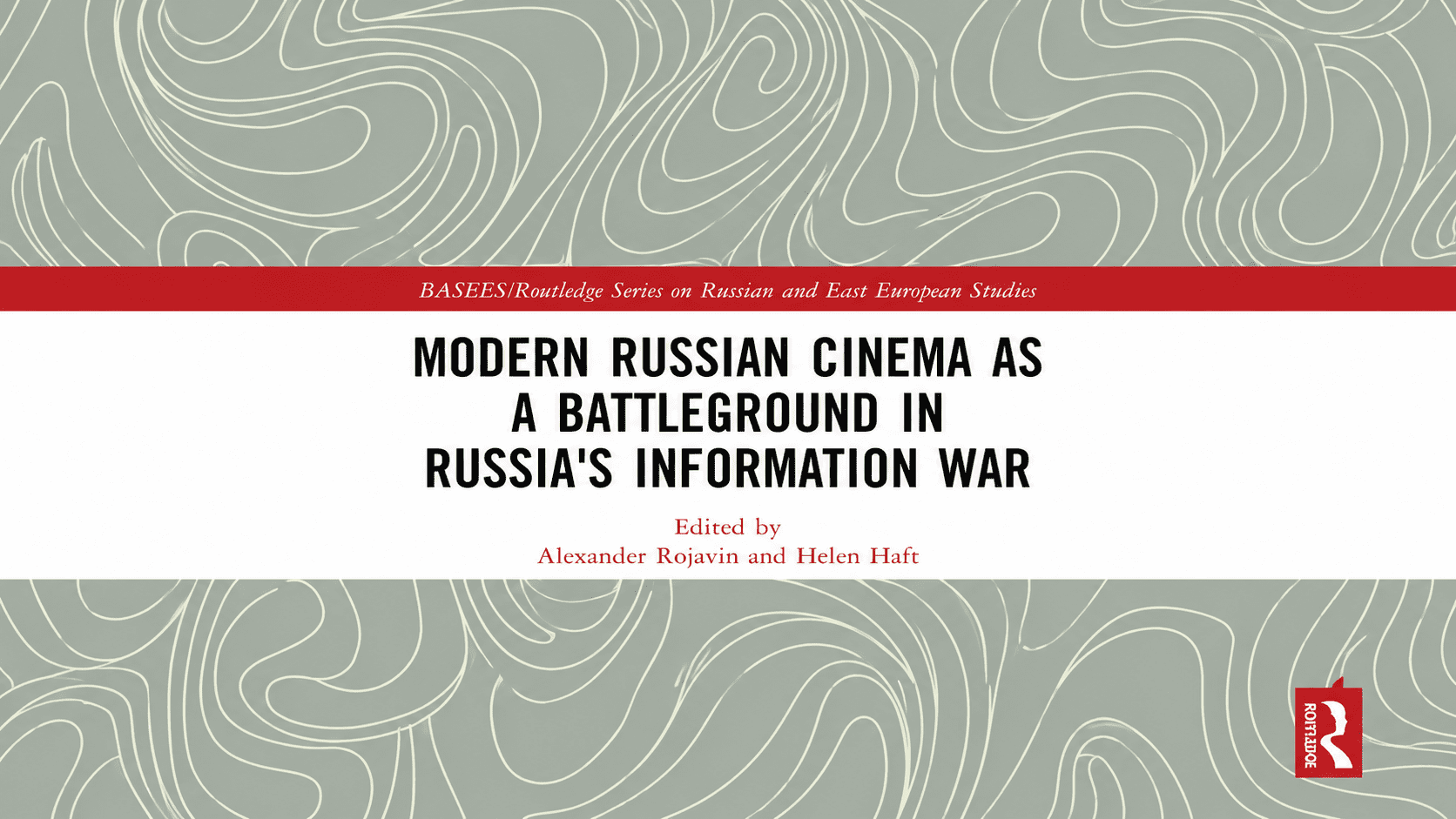
“Of all the arts, cinema is the most important for us” — this phrase, attributed to Lenin, captures well the early Bolshevik understanding of cinema’s political power. Already in the first years of Soviet rule, the Bolsheviks understood that film could do something that a political speech, a newspaper article, or a slogan could not always achieve: it could make ideology visible, emotional, and collectively experienced. Cinema reached people who did not read newspapers, lived far from the centre, or spoke another language. On screen, the state could tell audiences who was a hero, who was an enemy, which past deserved reverence, and which future had to be built. Soviet film culture developed early on from the understanding that the moving image could educate, mobilise, and shape political imagination. This historical background helps us better understand the point of departure of Modern Russian Cinema as a Battleground in Russia’s Information War, edited by Alexander Rojavin and Helen Haft. The book examines how Russian cinema, within political culture, is connected to power, historical memory, and the shaping of social imagination.
The collection explores contemporary Russian cinema at the intersection of information influence, cultural policy, and political communication. Its starting point is the idea that films help shape a society’s understanding of history, power, national identity, enemies, and moral order.
The volume shows how, over recent decades, the Russian film industry has moved increasingly towards state control, dependence on public funding, and ideological pressure. The authors approach film as part of a broader information environment that includes laws, funding models, censorship, distribution conditions, official historical narratives, media, and political institutions. This approach helps explain why propaganda cannot be reduced to isolated slogans or explicit political messages. Influence often works at a deeper level: it shapes recurring images, emotions, character types, plots, and value judgements.
The book discusses, for example, how the Russian Ministry of Culture justified its refusal to support the screening of Barbie and Oppenheimer by invoking the protection of “traditional spiritual and moral values”, while presenting The Witness as a suitable domestic alternative — a film that frames the Bucha massacre in a way aligned with Russian state propaganda. The collection also examines films in which Ukraine is depicted as a fascist and existentially dangerous space, while war is presented as an inevitable solution. The treatment of law and criminality adds another dimension: in films such as Leviathan, A Long Happy Life, and The Fool, law often appears as a mechanism of corruption, fear, helplessness, or political control.
The book helps us see film as a system that produces meaning. A war film, historical drama, or crime film can offer the viewer a particular understanding of who belongs to “us”, to whom guilt is assigned, which version of history is considered correct, and which forms of violence are presented as inevitable or justified. A critical viewer does not ask only whether a film is based on facts, but also what emotions and political conclusions the film is trying to produce.
The collection operates on several levels: from the economic and institutional structure of the film industry to specific narratives and genre conventions. On the one hand, the book explains how state funding, distribution channels, international isolation, and dependence on the domestic market affect which films are made and which audiences they reach. On the other hand, it shows how cinema shapes ideas about history, national unity, enemies, and political loyalty. Particular attention is given to the politics of memory surrounding the Second World War and the Holocaust, the portrayal of Ukraine as a threat, the normalisation of military intervention and private military structures, the politicisation of law and religion, and the reinterpretation of the Soviet dissident legacy.
The strength of the book lies in its analytical precision. The authors do not treat Russian cinema as a uniform mass of propaganda. They show that even within an authoritarian information environment, there are tensions, unevenness, contradictions, and different aesthetic choices. Some films directly support state narratives; others normalise them more indirectly; still others expose the system’s internal contradictions.
Modern Russian Cinema as a Battleground in Russia’s Information War is well suited to readers interested in Russian information influence, propaganda, film culture, historical memory, and critical media literacy. The book reminds us that images, stories, and genres often shape our perception of the world before we consciously notice their influence.