Anna-Maria Vaskovskaja, National Library of Estonia
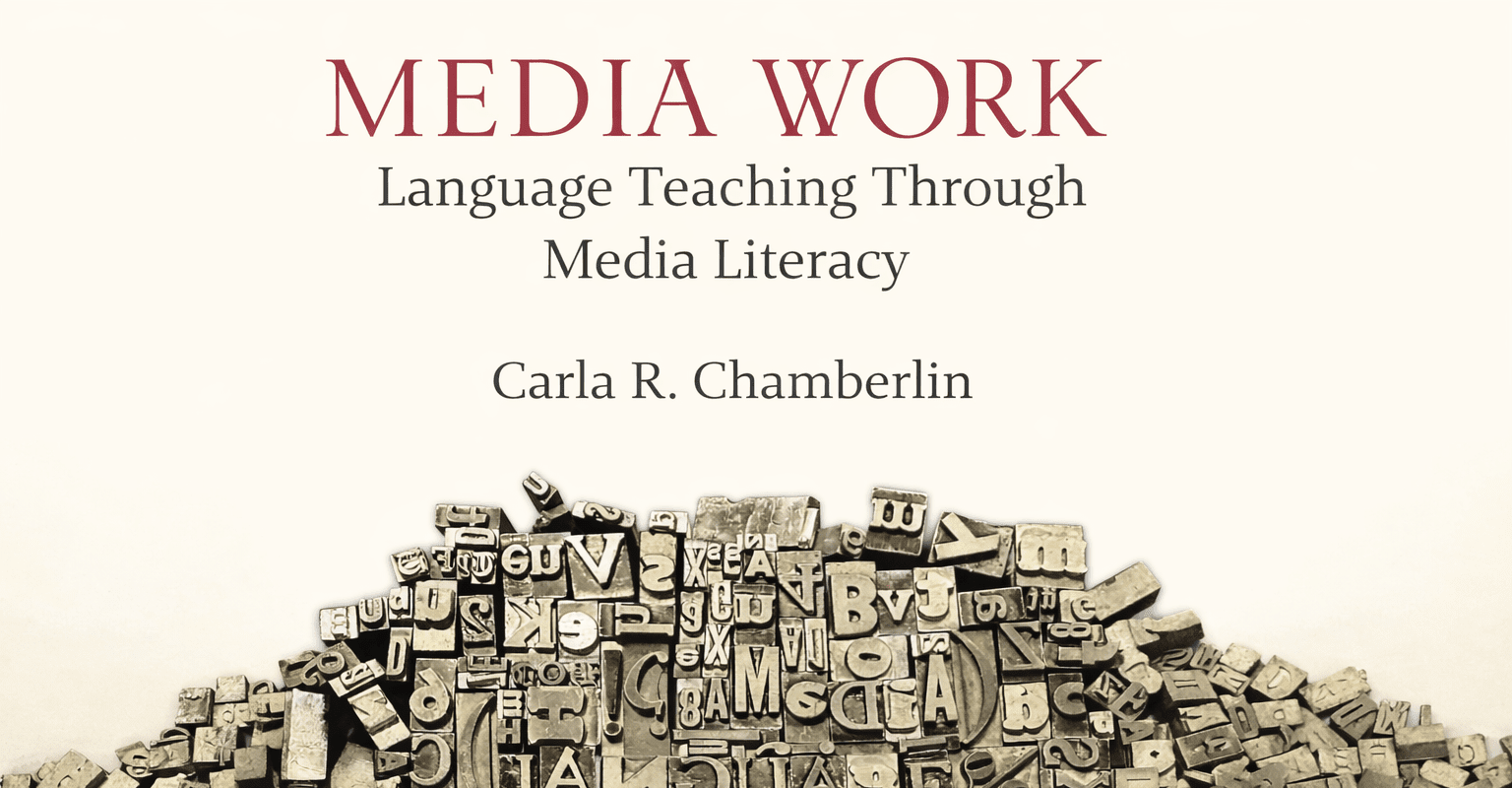
Carla R. Chamberlin is a faculty member in Applied Linguistics and Communication at Pennsylvania State University’s Abington College. Her teaching and research focus on second-language learning and teaching in new media environments, and on how language and media shape identities and attitudes, including perceptions of bilingualism and language policy.
Chamberlini raamat Media Work: Language Teaching Through Media Literacy seeks to show how media literacy can be a natural part of language learning. The author begins with the observation that in trainings and classes, screens, apps, and videos can quickly create a “wow effect,” yet the substantive question often fades into the background: what media actually does, which stereotypes and ideologies it reinforces, whose perspective dominates or is silenced, and whether learners even have equal access to these tools. Alongside this, she emphasizes the core message that technology does not automatically make teaching interactive or meaningful — what matters is how media is examined and what it is used for.
From observation to action
The book’s most practical thread is the author’s “media work” approach, which she describes as a process: observing, interrogating, interpreting, reflecting, and responding/taking action. The author recommends keeping the sequence intact so that, before opinions and conclusions, learners first do concrete observation (what exactly do I see or hear), only then interrogation (who is speaking, for what purpose, what sources are being relied on, and what may have been left out), and only after that move on to interpretation and reflection. This helps avoid discussions that stay on the level of emotion or drift into “I think”–type generalizations, and it guides learners to rely on visible evidence. From a language-learning perspective, this is useful because the same steps can be used to practise vocabulary, grammatical forms, and discourse — learners practise describing and justifying, and learn to distinguish between fact, interpretation, and evaluation.
Another important point is the author’s broad understanding of media. She doesn’t limit herself to mass media or social media, but also brings everyday media into the analysis — signs, labels, public notices, visual messages, community information, and short texts. Methodologically, this matters because it reduces reliance on devices and makes “media work” possible even when a classroom lacks technical access or when a digital divide is present. At the same time, it helps connect language learning to the community and real life, where learners are not only analyzing online texts but also the communication happening in their own environment.
Tunnis rakendamine: „Observing the World Around Us”
Oluline on ka autori lai meediakäsitus. Ta ei piirdu massimeedia või sotsiaalmeediaga, vaid toob analüüsi alla ka igapäevase meedia: sildid, etiketid, avaliku ruumi teated, visuaalsed sõnumid, kogukonna info ja lühitekstid. Metoodiliselt on see tähtis, sest vähendab sõltuvust seadmetest ja teeb “media work’i” võimalikuks ka siis, kui klassis puudub tehniline ligipääs või kui esineb digilõhe. Samal ajal aitab see siduda keeleõpet kogukonna ja päriseluga, kus õpilane ei analüüsi ainult internetis olevat teksti, vaid ka omaenda keskkonnas toimuvat kommunikatsiooni.
Chamberlin also emphasizes that “media work” should not become extra workload for the teacher or a separate lesson, but rather an integrated approach that helps connect existing activities in a more meaningful way. In practice, there is no need to create a new course: a standard text-based task, discussion, or writing assignment can be structured so that questioning and reflection move to the center. The book is designed for flexible use, allowing readers to move between chapters depending on the needs of the class and the teaching context, and the approach is easy to adapt to a group’s age and proficiency level, which makes it a handy guide. It offers theoretically grounded yet pedagogically flexible ways to integrate media literacy into the teaching of reading, writing, and second-language learning.
Overall, the book provides a clear process that trains students to observe, question, interpret, and justify — skills that are highly practical in language learning and increasingly important for navigating today’s broader information and media environment.