You have probably been sent a “shocking news story”, a “quote from a great person” or a photo that looks too good to be true in a group chat. One of the best Russian-language places to get to the bottom of such things is Provereno.Media (provereno means “verified” in Russian). It is a professional fact-checking project: the team checks news stories, photos, videos, quotes and myths that are already circulating, and explains in detail exactly how they did it.
Easy to use from the first click
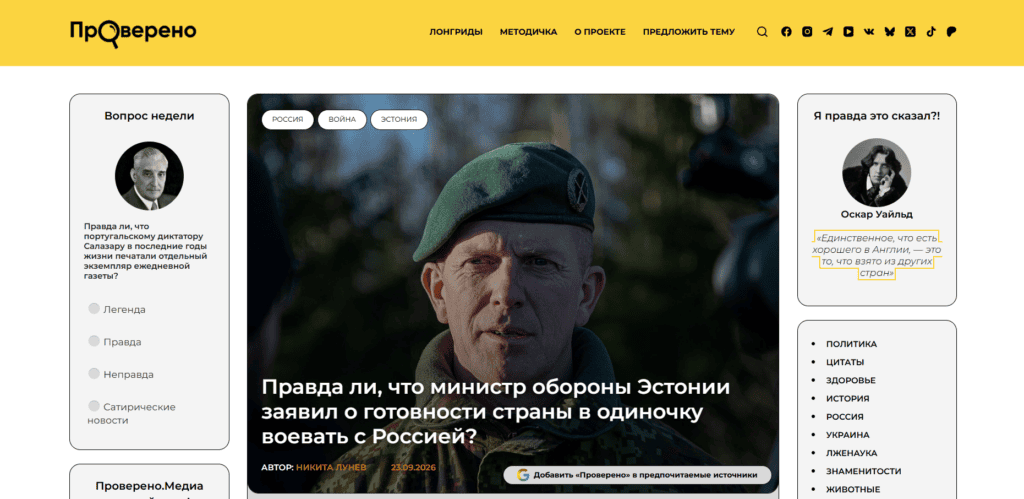
The site is simple yet highly professional. The best place to start is the search bar: it will immediately show whether the story that puzzled you has already been checked. Every fact-check follows the same structure – a question as the headline (“Is it true that…?”), the verification process with links to sources, and a verdict at the end – which makes them easy to navigate. Tags above the headline lead to collections of articles on the same topic. On either side of the page are two lively features: “Я правда это сказал?!” (“Did I really say that?!”), a quote attributed to a celebrity that you can check in one click, and “Вопрос недели” (“Question of the Week”), a mini quiz answered using the project’s own verdicts. The site footer contains the credibility rating scale, the corrections policy and the IFCN and EFCSN membership badges.
The key point: the whole check is visible
The site’s value lies not in its verdicts but in the fact that every fact-check shows the work step by step. A good example is the September story about Estonia’s new defence minister, Martin Herem. A “quote” of his spread on Telegram: Estonia was supposedly ready to fight Russia on its own, “cross the border and we’ll kill you all”, and Russia ought to break apart. The posts gathered almost two million views, and even Putin commented on the “statement”. Provereno took the quote apart and showed that it was a collage. One phrase came from Herem’s lecture at the University of Tartu in September 2026. Another came from his 2024 speech at the Academy of Sciences, where he had, on the contrary, explained why even victory would come at a bitter price for Estonia. A third came from a 2023 interview with ETV. The team even tracked down the earliest publication of the stitched-together quote: 20 September, 6:01 a.m. Moscow time, on a Telegram channel. All the original sources are linked, with archived copies. The verdict: “Distorted quote”. Read a couple of fact-checks like this and you will start spotting the same tricks yourself.
Tools in the “Методичка” section
This section (roughly “The Manual”) is a fact-checker’s library: a search toolkit, guides to verifying photos and videos, materials on AI, webinars and books. There are also simple practical pieces, such as how to check for yourself who really said a famous quote.
Not just “true or false”
Instead of two options, Provereno uses 17 verdicts – its credibility rating scale. The reasoning is simple: information is rarely a pure fake or one hundred per cent true, and a two-option scale can itself be misleading. Here is what is worth noticing:
- “False” (Неправда) and “Fake” (Фейк) are not the same thing. A fake is a deliberate forgery, while something false may simply be a mistake.
- “Taken out of context” (Вырвано из контекста): the photos, videos or quotes are genuine, but come with a false explanation.
- “Misconception” (Заблуждение): a widespread belief with no identifiable author that did not hold up under scrutiny.
- “Not certain” (Это не точно): an honest “we don’t know”. There is not enough information to confirm or refute the claim, and that does not mean the team didn’t try hard enough.
There are separate verdicts for quotes, satire, legends and scams. If a story mixes several techniques, the author and the editor choose the verdict together, and in difficult cases the whole editorial team decides. A handy tip: every verdict on the site is clickable. Click “Вырвано из контекста”, for example, and you will get a whole collection of examples to practise on.
You can take part
Seen a suspicious post? Send it in via the “Предложить тему” (“Suggest a topic”) form or the Telegram bot @proverenomediaBot. The form has a separate field for people who have already started checking: you can add the sources you have found and your own arguments. A good habit: don’t forward anything doubtful – start with one question instead: “Where did this come from?”
Who is behind the project
The project was founded by journalist Ilya Ber in 2020; the current editor-in-chief is Daniil Fedkevich. The publisher is a non-profit organisation registered in Tallinn. Provereno is a member of the international (IFCN) and European (EFCSN) fact-checking networks, which regularly review their members’ methods and transparency. That matters, because anyone can call themselves a fact-checker. In spirit, the project is closest to the American site Snopes: alongside politics and war, it tackles health myths, urban legends and “quotes from great people”. Its articles may be republished with attribution (CC BY licence, illustrations excluded). It is a good resource to recommend to Russian-speaking friends and relatives.
Worth knowing
The site is in Russian only. Not all of its funders are named publicly: the project cites the safety of staff in Russia, and EFCSN assessors have seen the financial documents. The site is blocked in Russia.
🔗 provereno.media | t.me/provereno_media
Meet in person
Ilya Ber, founder and publisher of Provereno, is our partner. He gives lectures and masterclasses in towns and cities across Estonia, and the schedule of upcoming events can be found on our website under “News and events”.